
Learn More about our other offerings:
Biosearch Technologies Oligo Synthesis
|
Lucigen Reagent Components
|
Rapid Genomics Genotyping Solutions
|
SeraCare
Please follow our guidelines to ensure that you send sufficient DNA for your genotyping project, and that it arrives at LGC, Biosearch Technologies in good condition.
When shipping DNA samples to Biosearch Technologies for a genotyping project, please ensure that you follow the guidelines below.
Failure to do so may result in a delay to your project. Please ensure that you have submitted your sample plate information to your project manager, using the appropriate DNA sample template, prior to shipping samples to Biosearch Technologies.
The quantity of DNA that is required will vary depending upon the scale of your genotyping project and upon the genome size of your study organism. DNA can be shipped to DNA in a dried down or liquid format, and it is always preferable to send in DNA at a higher concentration or mass than the minimum requirement. For detailed guidelines on the mass or volume of DNA to submit for your genotyping project, please download our factsheet.
Please note that the minimum mass of DNA that we accept per sample is 2 ng, and the minimum concentration that we accept per sample is 5 ng/µL (based on human genome size). Biosearch Technologies also requires a small additional spare mass/volume for the robotic pipetting process that we use in-house.
Allow a minimum of two no template control (NTC) wells per 96-well plate and four NTC wells per 384-well plate.
DNA samples should be submitted to Biosearch Technologies in 96- or 384-well plates.
Commonly received plate types include:
Please note: we are unable to accept 96-well plates with a well volume of greater than 0.8 mL. These plates are not compatible with our robotics systems. If use of these plates is unavoidable, we can transfer your samples to a compatible plate but this will incur an additional charge.
It is essential that all DNA sample plates that are shipped to our laboratories are sufficiently sealed to prevent sample leakage and contamination.
The use of sticky seals is typically not sufficient, and can result in substantial sample leakage (see Figure 1).
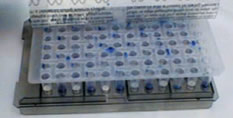
Figure 1 Test plate shipped using a sticky seal. Samples (blue liquid) have leaked across the surface of the plate and will result in cross-contamination between samples.
Biosearch Technologies recommends the use of two techniques for sealing of DNA sample plates:
All DNA sample plates that are sent to us must be barcoded or clearly labelled. The physical plate name must match the name given to the plate in the submitted DNA sample plate file.
Guidelines for labelling of plates
If you are submitting more than one DNA sample plate, please ensure that you place a cardboard spacer between each plate. This cardboard layer will prevent the bottom of one plate piercing the seal of the plate stacked below it (see Figure 2).
Wrap stacks of plates in bubble wrap to protect the wells during transit.
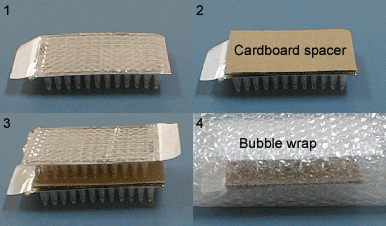
Figure 2. Preparation of several DNA sample plates for shipping. Place a cardboard spacer between each plate to prevent piercing of plate seals.
Biosearch Technologies recommends that DNA sample plates are shipped on dry ice. This will ensure that samples remain frozen during transit, thus minimising the possibility of sample leakage.
Please do not send packages on dry ice to arrive at our laboratories over a weekend; we will not receive these until Monday and there is a risk that the dry ice may thaw during this time.
For shipment of biological material to our laboratory sites in the UK and Germany, region specific conditions apply. Biosearch Technologies’ customer support can advise what conditions apply for your shipment, and support you in complying with these conditions. To prevent delays and potential loss of your samples, please contact Biosearch Technologies’ customer support before you ship your samples.
LGC Genomics GmbH
Ostendstraße 25, TGS Haus 8
12459 Berlin
Germany
| Europe, Middle East, and Africa | |
|---|---|
| UK | +44 1992 470 757 |
| Germany | +49 30 1663 54600 |
| North America, Latin America | |
| Wisconsin, USA | +1 888 575 9695 |
| Asia Pacific | |
| China | +8621-22509000 |
| Singapore | +65 6734 4800 |
