
Learn More about our other offerings:
Biosearch Technologies Oligo Synthesis
|
Lucigen Reagent Components
|
Rapid Genomics Genotyping Solutions
|
SeraCare
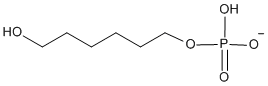
In general terms, a spacer is introduced into an oligonucleotide to add distance between the oligonucleotide and a modifier. This reduces the possibility of any adverse interaction between the modifier and the sequence. For instance, G-rich sequences are known to quench fluorescein therefore the use of a suitable spacer will remove the dye label from the proximity of the oligonucleotide minimising the quenching effect. In a similar fashion, spacers are often used to distance between multiple additions of self-quenching dyes e.g. fluorescein.(1) The application of the modified oligonucleotide will dictate whether a hydrophilic (Spacer 18 (HEG), Spacer 9 (TEG)) or hydrophobic spacer (Spacer C2, C3, C6, C12, C16) is required. Multiple incorporations of varying lengths of these spacers allow the precise length of the spacer arm to be controlled. This can be important in hairpin loop(2) and duplex studies(3) of DNA. Several spacers have specific uses. A C3 spacer mimics the three carbon spacing between the 3’ and 5’ hydroxyls of a sugar unit.(4) Although useful where the base at a specific site is unknown, the flexibility of the alkyl chain distorts the sugar-phosphate backbone. This can be alleviated with the use of dSpacer since incorporation of this modifier sits directly into the natural sugar-phosphate backbone with no adverse effect. This modifier mimics abasic sites(5) and is useful in the study of mutations resulting from depurination. Although less common than terminal spacing, but equally important, spacers have been incorporated within an oligonucleotide. This adds distance between sections of the sequence. For instance, Cytocell’s SMART detection assay(6) uses spacer 18 in the template probe where one section acts as an anchor in binding to the target leaving the other section free for hybridisation to the extension probe to allow amplification during PCR. In this case, the spacer gives flexibility to the template probe to enable hybridisation to both the target and the extension probe. In similar way, spacer 18 is used in Scorpion™ Primers to separate the probe and primer section. However in this case, this not only provides the flexibility to allow the probe to flip back to hybridise to the amplicon but also acts as a PCR blocker to prevent read through to the probe.(7) 3'-Spacers are often used as an alternative to 3'-phosphate as blockers since, when incorporated at the 3'-end, the resulting oligonucleotide shows nuclease and polymerase resistance. In fact, spacer C3 is often incorporated at the 3'-end of an oligonucleotide for use with restriction enzymes rather than phosphate since the latter is thought to partially cleave during the assay.
Ref:
Need some support with placing an order, setting up an account, or finding the right protocol?
Contact us| Europe, Middle East, and Africa | |
|---|---|
| UK | +44 1992 470 757 |
| Germany | +49 30 1663 54600 |
| North America, Latin America | |
| Wisconsin, USA | +1 888 575 9695 |
| Asia Pacific | |
| China | +8621-22509000 |
| Singapore | +65 6734 4800 |
