
Learn More about our other offerings:
Biosearch Technologies Oligo Synthesis
|
Lucigen Reagent Components
|
Rapid Genomics Genotyping Solutions
|
SeraCare
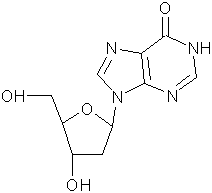
In sequencing applications, the design of primers can be complicated by the degeneracy of the genetic code (there are 64 possible 3-base codon configurations and only 21 amino acids, and therefore the third base in a sequence codon is often unknown). The problem of degeneracy can also be tackled by the use of universal bases.(1) Deoxyinosine is often used as a degenerate base in an oligonucleotide to alleviate this problem.(2) This is possible since its structure allows it to base pair with all four bases in various ‘wobble’ structures. However, the base-pairing is not equivalent with each of the 4 naturally occurring bases. The overall preferential order of base-pairing is: dI-dC > dI-dA > dI-dG = dI-dT. We provide both dI phosphoramidite and CPGs. 2'-Deoxynebularine(3) is another example. In a true universal nucleoside, the base analogue does not hybridize significantly to the other four bases and makes up some of the duplex destabilization by acting as an intercalating agent. 3-nitropyrrole 2'-deoxynucleosides were the first example of a set of universal bases. Subsequently, 5-nitroindole was determined to be an effective universal base and to be superior to 3-nitropyrrole, based on duplex melting experiments.
Ref:
Need some support with placing an order, setting up an account, or finding the right protocol?
Contact us| Europe, Middle East, and Africa | |
|---|---|
| UK | +44 1992 470 757 |
| Germany | +49 30 1663 54600 |
| North America, Latin America | |
| Wisconsin, USA | +1 888 575 9695 |
| Asia Pacific | |
| China | +8621-22509000 |
| Singapore | +65 6734 4800 |
